
Understanding the Signs You Need a Root Canal
Many patients in Surat share a common story: a nagging toothache or sensitivity they hoped would disappear. It’s natural to delay dental work, especially with “root canal” mentioned. But delaying treatment for signs you need a root canal often worsens the problem, leading to more complex, painful, and costly interventions. Early recognition is your best defense.
What are the Signs You Need a Root Canal?
Understanding your body’s dental signals is paramount. We look for specific signs indicating deep infection or irreversible pulp damage. The tooth’s pulp, containing nerves, blood vessels, and connective tissue, demands prompt attention when infected or inflamed.
Persistent Pain
Persistent toothache is the most common warning sign. This isn’t fleeting discomfort; it’s continuous, throbbing, or sharp pain that doesn’t subside. It might be constant or intensify with chewing, pressure, or lying down, indicating an inflamed or infected nerve.
Sensitivity to Hot and Cold Temperatures
Lingering sensitivity to hot and cold temperatures is a major clue. If discomfort persists for seconds or minutes after sipping hot chai or biting cold dessert, it’s a tell-tale sign. Healthy teeth react briefly; an infected pulp holds the sensation.
Gum Swelling and Tenderness
Never ignore swelling and tenderness in gums around a tooth. Localized swelling, like a gum “pimple,” fistula, or abscess, often indicates draining pus from an underlying infection. You might notice a bad taste.
The biggest mistake we see is people waiting for the pain to become unbearable. By then, the infection is usually more advanced, and treatment can be more challenging. Early detection truly makes a difference.
Understanding the “Why”: What Leads to a Root Canal?
Understanding the root causes helps. Root canals are primarily due to pulp damage or infection from several factors:
- Deep Decay: Untreated cavities can progress, eroding through enamel and dentin, reaching the pulp chamber. Once bacteria invade, infection sets in.
- Repeated Dental Procedures: Multiple fillings or restorative treatments on the same tooth can stress the pulp, leading to inflammation or damage over time.
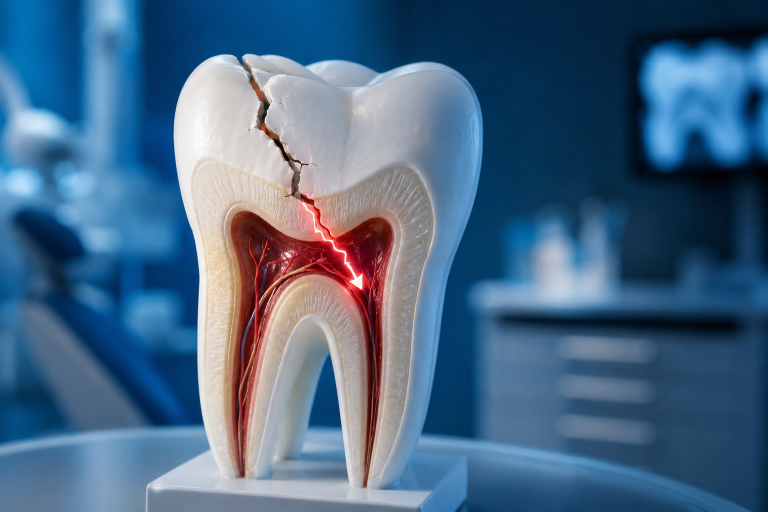
- Cracks or Chips: These create entry points for bacteria, compromising the pulp’s sterile environment.
- Trauma: A blow to the face or mouth can damage the tooth, even without visible chips or cracks. This trauma can sever the blood supply to the pulp, causing it to die and become susceptible to infection.
Did You Know?
Root canal treatments have advanced; with local anesthesia and modern techniques, the procedure is often no more uncomfortable than a filling.
Statistics
According to the American Association of Endodontists, over 15 million root canals are performed every year in the United States.
Don’t wait for dental discomfort to escalate. Contact 32 Denti Care in Surat today to schedule your consultation and get the expert care you deserve.

Q? Will a root canal hurt?
A. Modern root canal treatments are designed to relieve pain, not cause it. With advanced local anesthesia techniques, the procedure itself is typically no more uncomfortable than getting a standard filling. The discomfort you experience before the treatment, due to infection or inflammation, is usually far worse than the treatment itself.
Q? How long does a root canal treatment take?
A. The duration of a root canal treatment can vary depending on the complexity of the tooth’s anatomy and the extent of the infection. Generally, it can be completed in one or two appointments, each lasting between 60 to 90 minutes. Your dentist will provide a more precise estimate during your consultation.
Q? What happens if I don’t get a root canal when it’s needed?
A. Ignoring the need for a root canal can lead to severe consequences. The infection can spread to other parts of your body, causing a dental abscess, bone loss, or even systemic health problems. Eventually, the tooth may need to be extracted, which can lead to further complications like shifting teeth or the need for more extensive restorative procedures like implants or bridges.
Q? Can a tooth treated with a root canal get another infection?
A. While rare, it is possible for a treated tooth to become reinfected. This can happen if the initial cleaning was incomplete, new decay develops, the crown or filling leaks, or if there’s an undetected crack. In such cases, a retreatment or other interventions may be necessary to address the recurring issue and save the tooth.
Q? What should I expect after a root canal?
A. After a root canal, it’s normal to experience some mild sensitivity or discomfort for a few days, which can usually be managed with over-the-counter pain relievers. Your tooth will typically require a crown or permanent filling to protect it from fracture and restore its full function. Following your dentist’s post-treatment instructions and maintaining good oral hygiene are crucial for long-term success.